
I. What is Expository Preaching?
- Sermons come from the Bible
- They must connect to real life
II. The Three Worlds of a Preacher
1. Biblical World (Then)
- What did it mean before?
2. Present World (Now)
- What are people facing today?
3. Local World (Your People)
- Who are you preaching to?
III. Role of the Preacher
- Teach and care for people
- Know:
- The Bible
- The times
- The people
IV. God’s Word is for Today
👉 God’s Word is not only past—it speaks now
V. From Study to Sermon
- Study the Bible
- Study the people
- Connect truth to life
VI. The Problem
- Sermons can be:
- Dry
- Lifeless
👉 Goal:
Make sermons alive
VII. How to Develop a Sermon
👉 4 Ways:
- Restate
- Explain
- Prove
- Apply
VIII. Stage 4: Three Key Questions
1. WHAT DOES THIS MEAN? (Explain)
Focus:
- Bible → What does it mean?
- People → Do they understand?
Goal:
👉 Be clear
2. IS IT TRUE? (Prove)
Focus:
- Can people believe it?
Methods:
- Scripture
- Experience
- Logic
- Evidence
Goal:
👉 Move from doubt → belief
3. WHAT DIFFERENCE DOES IT MAKE? (Apply)
A. Main Idea
👉 People ask:
“So what?”
B. Why Application Matters
- The Bible is not just for knowledge
- It must be:
- Obeyed
- Lived
👉 Without application:
- People may believe truth but live wrongly
C. Key Principle
👉 Right application starts with right interpretation
- First:
- Understand what the passage meant before
- Then:
- Apply it today
D. Compare Then and Now
- Ask:
- What is the same?
- What is different?
1. When Situation is the Same
👉 Application is direct
Example:
- “Be slow to anger” (James)
✔ Applies to all people today
2. When Situation is Different
👉 Application must be careful
Example:
- Slaves vs Employees
✔ Principle applies
❌ Situation is not the same
E. Dangers in Application
- Wrong Interpretation
- Not understanding the passage
- Allegorizing
- Adding meaning not in the text
- Forcing Ideas
- Using your own beliefs, not the Bible
F. Source of Application
👉 Application must come from:
- The author’s purpose
- The meaning of the text
G. Importance of Context
- Study:
- Whole book
- Not just one verse
👉 Context controls meaning
H. Questions to Help Application
About the Text
- What is the purpose?
- What is God teaching?
- Is this:
- Example?
- Warning?
About the People
- What do we share with them?
- How are we different?
- How did they respond to God?
About Today
- What should we:
- Think?
- Feel?
- Do?
- What stops people from obeying?
I. Applying to Modern Issues
- Some issues are not directly in the Bible:
- Technology
- Politics
- Modern ethics
👉 So we use:
- Biblical principles
J. Wise Application Requires
- Right understanding of facts
- Right understanding of Scripture
- Careful thinking
👉 Principle:
Faith + Facts = Wise Decisions
K. Final Application Goal
👉 Change:
- Thoughts
- Attitudes
- Actions
IX. Final Summary of the 3 Questions
- Explain → What does it mean?
- Prove → Is it true?
- Apply → What should we do?
X. Final Sermon Formula
👉
Clear Meaning
- Strong Proof
- Real Application
= Powerful Sermon
XI. Final Truth
👉 If people:
- Don’t understand → no clarity
- Don’t believe → no conviction
- Don’t apply → no change
XII. Ultimate Goal of Preaching
👉 Bring:
- God’s Word
- To real people
- So their lives will change
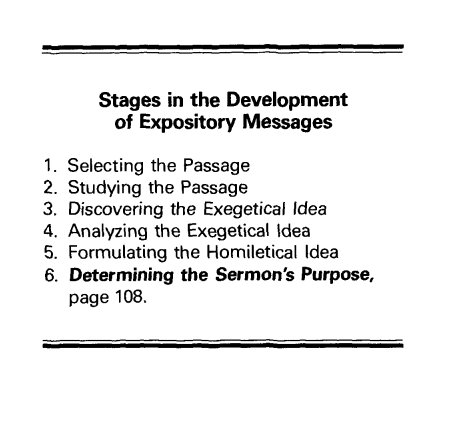
Stage 5 – Formulating the Homiletical Idea
- Purpose:
After studying the passage and understanding the audience, the preacher must distill the message into a single, precise, and memorable statement. This statement—called the homiletical idea—guides the sermon’s direction and identifies the key questions to address in exposition. - Key Principles:
- A homiletical idea connects the biblical text with the audience’s life.
- People often adopt ideas more readily when phrased memorably—think of slogans—but unlike ads, the preacher’s idea must be true, substantial, and rooted in Scripture.
- A universal biblical principle may serve as both the exegetical and homiletical idea (e.g., Luke 12:15: “Beware of covetousness, for life does not consist in the abundance of possessions”).
- Some ideas need personal or contemporary phrasing to resonate with the audience (e.g., I Timothy 4:12-16 → “Young men win respect by giving attention to their personal lives and to their teaching.”).
- Process of Development:
- Extract the exegetical idea: what the passage actually says.
- Translate it into a homiletical idea: a concise, memorable expression relevant to the congregation.
- Ask:
- What does this mean? (Explanation)
- Is it true? (Validation)
- So what? (Application/Implications)
- Characteristics of a Good Homiletical Idea:
- Winsome and compelling without being sensational.
- Clear, memorable, and easily repeatable.
- Faithful to the Bible yet meaningful for the listener today.
- Sparks thought and action.
- Examples: PassageExegetical IdeaHomiletical IdeaLuke 12:15Life does not consist in possessionsBeware of covetousnessI Thess 1:2-6Paul thanked God for their faith, hope, and loveWe can thank God for others because of what they do for HimI Timothy 4:12-16Timothy should live exemplary and teach diligentlyYoung men win respect by attending to life and teachingRomans 6:1-14Union with Christ frees us from sinYou can’t live as you once did because you are no longer the person you once wereJames 1:1-16Trials test faithYour reaction to trials is a matter of life and death
💡 Bottom line:
The homiletical idea is the sermon’s heartbeat. When the preacher grasps it “clear as a cloudless moon,” the message naturally follows, both faithful to Scripture and alive to the audience.
Here’s a detailed breakdown of each exercise with subject, complement, and functional question:
1. John W. Gardner
“The reason you can’t teach an old dog new tricks is not that he is incapable of learning them…”
- Subject: The reason you can’t teach an old dog new tricks
- Complement: Is that he is quite content with his mastery of the old tricks and thinks that learning new tricks is strictly for puppies
- Functional question being addressed: Why do some people resist learning new things even when they are capable?
2. Edith Schaeffer
“The powerful voice of God warns of judgment…”
- Subject: The powerful voice of God
- Complement: Warns of judgment and expresses His compassion for those who return to Him
- Functional question being addressed: How should we respond to God’s communication and authority?
3. New York Times
“The best thing you can do for your golf this winter is look in a mirror…”
- Subject: The best thing you can do for your golf this winter
- Complement: Is look in a mirror
- Functional question being addressed: How can a golfer improve during the off-season?
4. Texas Monthly
“More contagious than colds, more habit-forming than hard drugs, CB radio already affects more than 15 million Americans…”
- Subject: CB radio
- Complement: Affects more than 15 million Americans and is becoming extremely popular
- Functional question being addressed: How has CB radio influenced American culture?
5. Chinese boy and jade story
“A Chinese boy who wanted to learn about jade went to study with a talented old teacher…”
- Subject: The boy’s learning process
- Complement: Led to sudden insight: recognizing jade after weeks of preparation
- Functional question being addressed: How do we truly learn and recognize understanding—through experience and practice, not just instruction?
6. Rudolph Fellner / William Mayer
“Rudolph Fellner reminds his classes that ‘melody exists only in your memory…’”
- Subject: Melody
- Complement: Exists only in memory; each note gains meaning from what preceded it
- Functional question being addressed: What is the nature of music and how do we perceive it?
7. Elliot L. Richardson
“Had security guard Frank Wills not noticed a taped door lock at the Watergate office…”
- Subject: The discovery of the Watergate burglary
- Complement: Revealed abuses of government power and affected the course of history
- Functional question being addressed: How did a single act of vigilance influence American government and society?
8. Sport and Society
“Work today has lost many traditional characteristics; so has play…”
- Subject: Play and sports
- Complement: Have increasingly become like work, except in hunting and fishing
- Functional question being addressed: How have modern sports and work influenced each other and changed in character?