
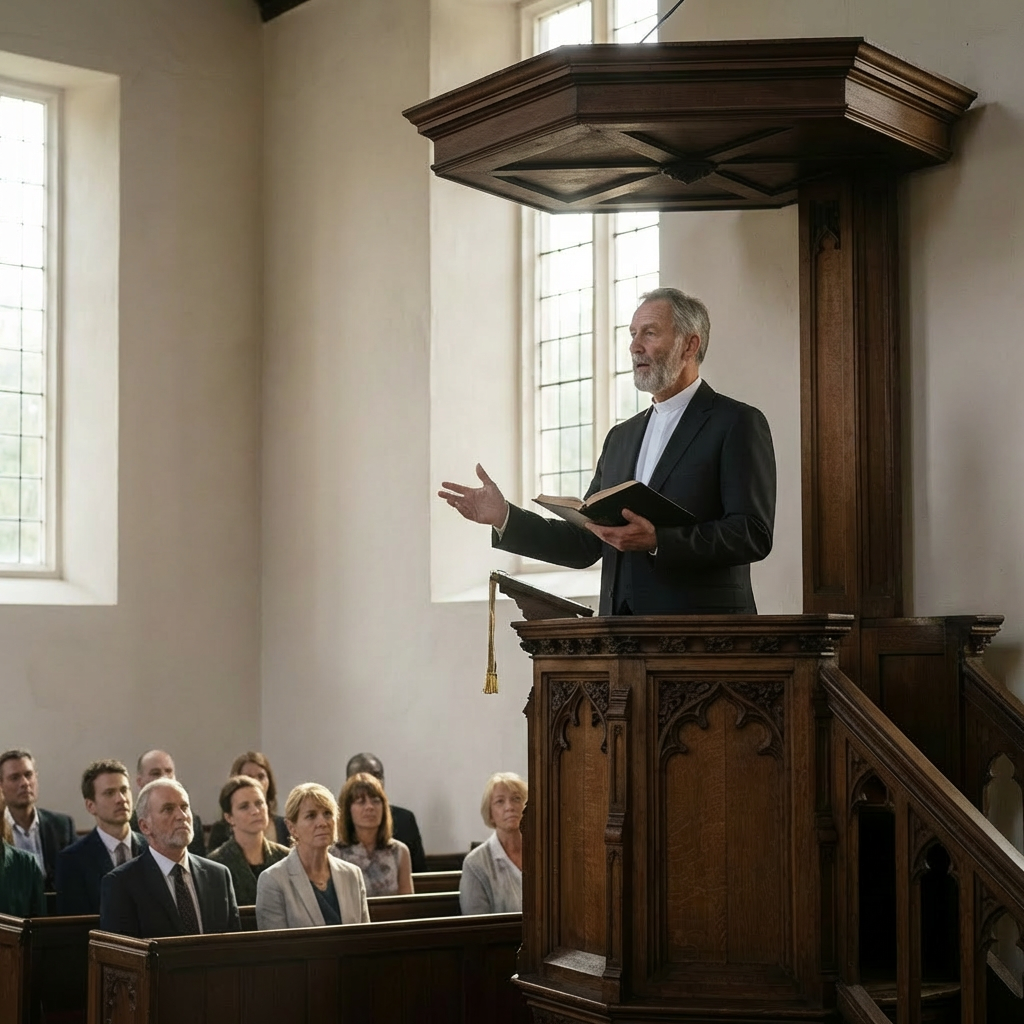
I. THE NATURE OF EXPOSITORY PREACHING
1. Definition
1.1 Expository preaching draws truth from Scripture
1.2 It relates biblical truth to life today
1.3 Goal: Not just explanation, but transformation
2. The Three Worlds of the Expositor
2.1 The Biblical World (Then)
2.1.1 Study history, culture, and language
2.1.2 Understand original meaning
2.1.3 Do careful exegesis
2.2 The Contemporary World (Now)
2.2.1 Understand current culture and issues
2.2.2 Address real-life questions
2.2.3 Avoid irrelevant, “religious language” preaching
2.3 The Particular World (Here)
2.3.1 Know your specific congregation
2.3.2 Understand their needs and struggles
2.3.3 Apply truth personally
3. The Role of the Pastor-Teacher
3.1 Preaching = care of souls
3.2 Must unite:
- Teaching
- Shepherding
3.3 Know both:
- The Bible
- The people
4. Bringing the Three Worlds Together
4.1 Combine:
- Then (Bible)
- Now (culture)
- Here (audience)
4.2 God’s Word is already relevant
4.3 The preacher shows its present reality
II. FROM EXEGESIS TO SERMON DEVELOPMENT
5. The Problem
5.1 Exegesis alone can be:
- Dry
- Lifeless
5.2 Goal:
→ Make the message alive and practical
6. Four Ways to Develop an Idea
6.1 Restatement
6.2 Explanation
6.3 Proof
6.4 Application
III. DEVELOPMENT METHOD #1: RESTATEMENT
7. Definition
7.1 Saying the same idea in different words
8. Purpose
8.1 Clarify
8.2 Emphasize
9. Biblical Examples
9.1 Hebrew poetry (parallelism)
9.2 Paul (Galatians 1:8–9)
9.3 Jeremiah (repeated judgment)
10. Limitation
10.1 Useful but not primary method
IV. DEVELOPMENT METHOD #2: EXPLANATION
11. Key Question
→ “What does this mean?”
12. Focus on the Text
12.1 Observe how the author explains
12.2 Example: 1 Corinthians 12 (body analogy)
13. Focus on the Audience
13.1 Identify what needs explanation
13.2 Bridge cultural gaps
14. Examples Requiring Explanation
14.1 Food sacrificed to idols
14.2 Weak vs strong brother
14.3 Baptism of the Holy Spirit
15. Importance of Clarity
15.1 Preaching must be understandable
15.2 Avoid jargon
15.3 Speak plainly
16. Practical Principle
16.1 Imagine listener asking:
→ “What do you mean?”
V. DEVELOPMENT METHOD #3: PROOF
17. Key Question
→ “Is it true?”
18. The Need for Proof
18.1 People question truth
18.2 Must provide evidence
19. Biblical Methods of Proof
19.1 Scripture
19.2 Logic
19.3 Experience
19.4 Illustration
20. Examples
20.1 Paul (1 Corinthians 9 – wages principle)
20.2 Peter (Acts 2 – history + Scripture)
20.3 Paul at Mars Hill (Acts 17 – culture-based reasoning)
21. Adapting to Audience
21.1 Use familiar references
21.2 Connect truth to real life
22. Addressing Modern Doubt
22.1 Expect skepticism
22.2 Engage real questions
23. Handling Difficult Issues
23.1 Example: Romans 8:28
23.2 Address suffering honestly
24. Tools for Proof
24.1 Analogy
24.2 Illustration
24.3 Logical reasoning
24.4 Real-life examples
VI. DEVELOPMENT METHOD #4: APPLICATION
25. Key Question
→ “What difference does it make?”
26. Importance of Application
26.1 Completes the sermon
26.2 Leads to obedience
27. Problem of Weak Application
27.1 People know truth but don’t live it
27.2 Result: inconsistency
28. Foundation: Exegesis
28.1 Must understand original meaning first
29. Identifying Original Context
29.1 Define original situation
29.2 Compare with today
30. Direct Application
30.1 When situations are similar
30.2 Example: James 1:19–20
31. Indirect Application
31.1 When situations differ
31.2 Example: slaves → employees
32. Dangers in Application
32.1 Allegorizing
32.2 Misusing Scripture
32.3 Proof-texting
33. Key Principle
33.1 Apply based on author’s intent
34. Importance of Context
34.1 Study whole passage
34.2 Study whole book
35. Discovering Author’s Purpose
35.1 Look for purpose statements
35.2 Identify theological judgments
35.3 Analyze narratives
35.4 Ask why included
36. Questions for Application
36.1 What is similar/different today?
36.2 What human experiences are shared?
36.3 What further revelation clarifies it?
37. Practical Application
37.1 What should change?
- Thoughts
- Attitudes
- Actions
38. Personal Application
38.1 Preacher must apply first
38.2 Identify obstacles
38.3 Offer guidance
39. Applying to Modern Issues
39.1 Use biblical principles
39.2 Think carefully
40. Testing Application
40.1 Are facts correct?
40.2 Are principles biblical?
40.3 Is interpretation accurate?
41. Faith and Facts
41.1 Both are needed for decisions
42. Summary of Development
42.1 Explain → Understand
42.2 Prove → Believe
42.3 Apply → Transform
VII. STAGE FIVE: THE HOMILETICAL IDEA
43. Definition
43.1 A clear, concise statement of the sermon’s main idea
44. Purpose
44.1 Guides the sermon
44.2 Connects Bible and audience
45. Power of a Well-Stated Idea
45.1 Memorable phrases shape thinking
45.2 Thinking shapes living
46. When No Change Is Needed
46.1 Universal truths remain the same
Examples:
- Luke 12:15
- Proverbs 15:1
- Habakkuk 2:4
47. When Refinement Is Needed
47.1 Simplify complex ideas
47.2 Make them direct
48. Making It Personal
48.1 Speak to the listener directly
49. Making It Contemporary
49.1 Use modern language
49.2 Keep biblical meaning
50. Examples of Homiletical Ideas
50.1 “You can’t live the old life because you are a new person”
50.2 “Your neighbor is anyone whose need you can meet”
50.3 “Your response to trials shapes your life”
50.4 “Everyone needs new birth”
51. Qualities of a Strong Idea
51.1 Clear
51.2 Concise
51.3 Memorable
51.4 Relevant
51.5 Accurate
52. Testing the Idea
52.1 Is it biblical?
52.2 Is it clear?
52.3 Is it memorable?
52.4 Is it applicable?
53. Final Principle
53.1 The homiletical idea is the heart of the sermon
FINAL SUMMARY: THE COMPLETE PROCESS
From Text to Sermon
- Study the text (Exegesis)
- Understand the meaning
- Explain clearly
- Prove truth
- Apply to life
- State one clear idea
Ultimate Goal
→ Life transformation through God’s Word
Chapter 5
