
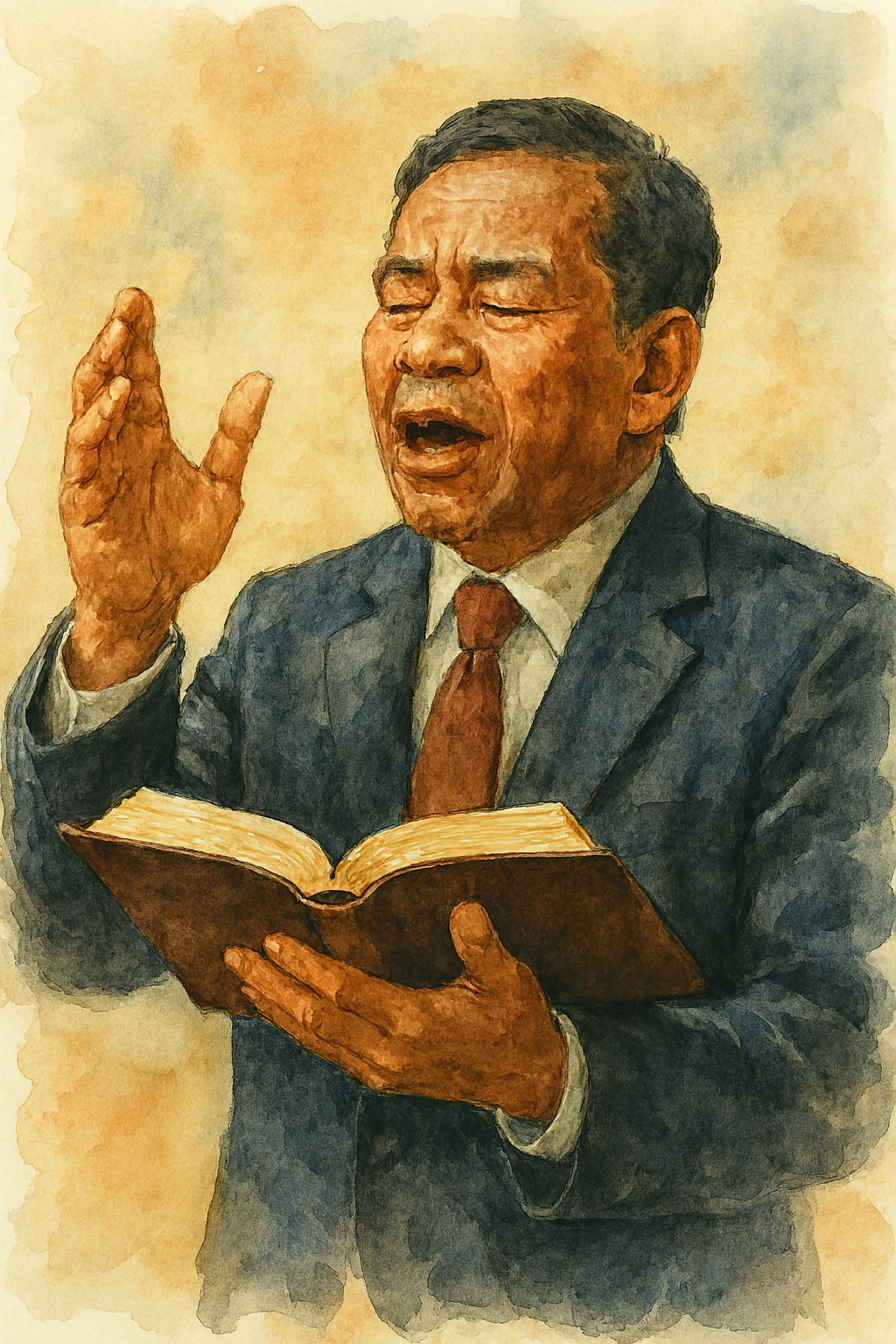
Our definition of expository preaching goes on to say that the truth must be applied to the personality and experience of the preacher. This places God’s dealing with the preacher at the center of the process. As much as we might wish it otherwise, the preacher cannot be separated from the message. Who has not heard some devout brother pray in anticipation of a sermon, “Hide our pastor behind the cross so that we may see not him but Jesus only.” We commend the spirit of such a prayer. Men and women must get past the preacher to the Savior. (Or perhaps the Savior must get past the preacher to the people!) Yet no place exists where a preacher may hide. Even a large pulpit cannot conceal him from view.
Phillips Brooks was on to something when he described preaching as “truth poured through personality.” The man affects his message. He may be mouthing a scriptural idea yet remain as impersonal as a telephone recording, as superficial as a radio commercial, or as manipulative as a “con” man. The audience does not hear a sermon; they hear a man.
Bishop William A. Quayle had this in mind when he rejected standard definitions of homiletics.
“Preaching is the art of making a sermon and delivering it?” he asked. “Why no, that is not preaching. Preaching is the art of making a preacher and delivering that!”
Expository preaching should develop the preacher into a mature Christian. As the expositor studies his Bible, the Holy Spirit studies him. When a man prepares expository sermons, God prepares the man. As P. T. Forsyth said, “The Bible is the supreme preacher to the preacher.”
Some of these aids will be discussed in Chapter 3. The Case for Expository Preaching Distinctions made between “studying the Bible to get a sermon and studying the Bible to feed your own soul,” are misleading and false. A scholar may examine the Bible as Hebrew poetry or as a record of the births and reigns of long-dead kings and yet not be confronted by its truth. Yet no such detachment can exist for one who opens the Book as the Word of God.
Before a man proclaims the message of the Bible to others, he should live with that message himself. Regrettably, many preachers fail as Christians before they fail as preachers because they do not think biblically.
A significant number of ministers—many of whom profess high regard for the Scriptures—prepare their sermons without consulting the Bible at all. While the sacred text serves as an appetizer to get a sermon underway or as a garnish to decorate the message, the main course consists of the preacher’s own thought or someone else’s thought warmed up for the occasion. Even in what is billed as “expository preaching,” the verses can become launching pads for the preacher’s own opinions.
One common recipe found in homiletical cookbooks reads something like this:
“Take several theological or moral platitudes, mix with equal parts of ‘dedication,’ ‘evangelism,’ or ‘stewardship,’ add several ‘kingdoms’ or ‘the Bible says,’ stir in a selection of stories, add ‘salvation’ to taste. Serve hot on a bed of Scripture verses.”
Such sermons not only leave a congregation undernourished; worse, they starve the preacher. He does not grow because the Holy Spirit has nothing to feed him.
William Barclay diagnosed the cause of spiritual malnutrition in a minister’s life when he wrote:
“The more a man allows his mind to grow slack and lazy and flabby, the less the Holy Spirit can say to him. True preaching comes when the loving heart and the disciplined mind are laid at the disposal of the Holy Spirit.”
Ultimately God is more interested in developing messengers than messages, and since the Holy Spirit confronts men primarily through the Bible,
4. A Spiritual Autobiography (Grand Rapids: Eerdmans, 1975).
Biblical Preaching a preacher must learn to listen to God before he speaks for Him.
