
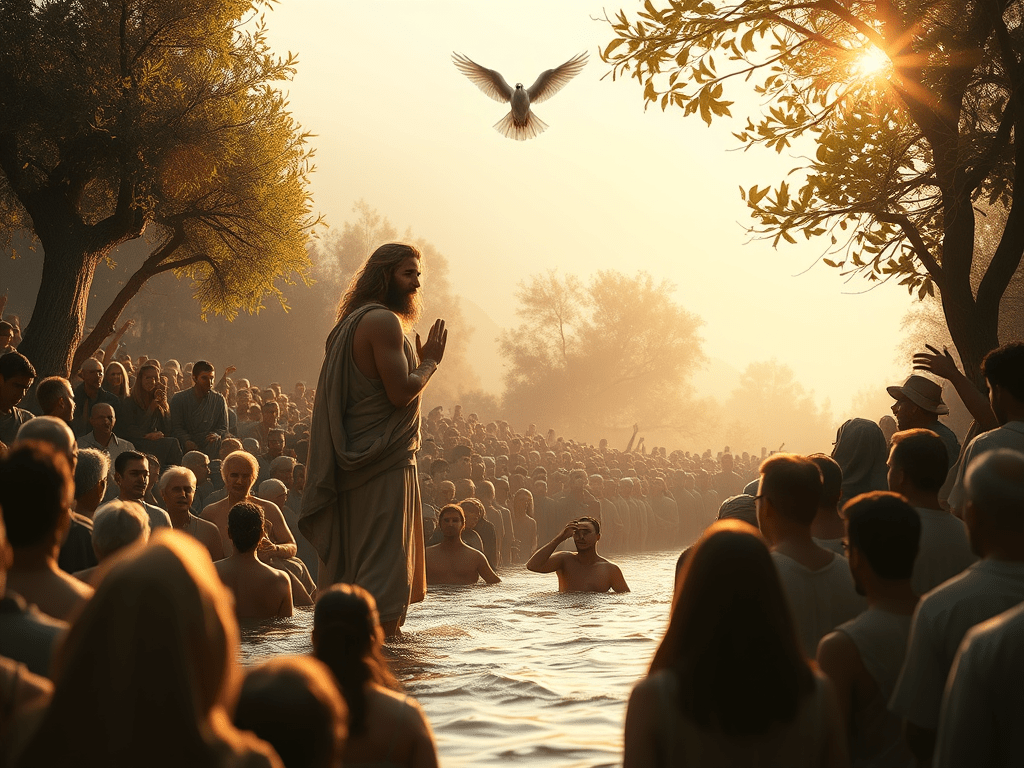
The beginning of John the Baptist’s ministry and Jesus Christ’s earthly ministry marked a pivotal moment in the New Testament. John, the son of Zechariah and Elizabeth, emerged as a prophet with a unique mission: to prepare the way of the Lord. Dressed in simple clothing and preaching in the wilderness of Judea, John called people to repentance and baptized them in the Jordan River. His bold preaching attracted large crowds and stirred a spiritual awakening, fulfilling Isaiah’s prophecy of a “voice crying out in the wilderness.”
The voice of him that crieth in the wilderness, Prepare ye the way of the LORD, make straight in the desert a highway for our God. (Isaiah 40:3 KJV)
Shortly after John began his ministry, Jesus came to be baptized by him, marking the start of His earthly ministry. At Jesus’ baptism, a remarkable event occurred: the Holy Spirit descended on Him like a dove, and a voice from heaven declared Him as God’s beloved Son. This moment affirmed Jesus’ identity and mission, setting Him on a path to preach, teach, and build His church.
Jesus’ ministry began with a call to repentance and faith, and a message of God’s love and forgiveness, drawing followers and transforming lives. Both John and Jesus preached with authority, but while John prepared the people, Jesus fulfilled the prophecies as the promised Savior. He also called out the baptized disciples and assembled and commissioned them as a church to preach the gospel, baptize, and teach.
The Silent Years
The “silent years” refer to the roughly 400-year period between the end of the Old Testament and the beginning of the New Testament. This is from the last prophetic writings in the Old Testament, (with the prophet Malachi), until the arrival of John the Baptist and the ministry of Jesus Christ in the New Testament.
By the time John the Baptist began his ministry (as seen in the Gospels), the Jewish people were ready for a significant change. John proclaimed the coming of the Messiah, signaling the end of the silent years and the beginning of God’s new revelation through Christ. This period of preparation meant that by the time Jesus began his public ministry, many people were primed for the fulfillment of prophecies and the arrival of a Savior.
The fulness of time
But when the fulness of the time was come, God sent forth his Son, made of a woman, made under the law, (Galatians 4:4 KJV)
The “fullness of time” emphasizes God’s purposeful and perfect timing, surpassing human concepts of time measurement. While we rely on years and dates to frame events, God’s plan unfolds according to a different rhythm, shaped by spiritual, cultural, and historical readiness. Jesus’ arrival was a pivotal event in human history, so profound that it redefined how time itself was marked, forever shifting the timeline to reflect His life and ministry’s enduring impact.
The concept of the “silent years” and the “fullness of time” are closely connected in the Bible and Christian thought. While the silent years (the 400-year gap between the Old and New Testaments) may seem like a period of waiting, they were also a period of preparation, during which God was setting the stage for the coming of Christ. The “fullness of time” describes the moment when God, having orchestrated these preparations, chose to send Jesus into the world, as referenced in Galatians 4:4: “But when the fullness of time had come, God sent forth his Son, born of a woman, born under the law.”
In those days
In those days came John the Baptist, preaching in the wilderness of Judaea, And saying, Repent ye: for the kingdom of heaven is at hand. For this is he that was spoken of by the prophet Esaias, saying, The voice of one crying in the wilderness, Prepare ye the way of the Lord, make his paths straight. (Matthew 3:1-3 KJV)
The phrase “in those days” at the beginning of Matthew 3:1 is a somewhat broad expression, referring to a general period rather than a specific date. In the context of the Gospel of Matthew, it relates to the time just before the beginning of Jesus’ public ministry. This was a transitional period when John the Baptist appeared in the wilderness, calling people to repentance and preparing the way for Jesus. The phrase connects the narrative of Jesus’ birth and early years (as described in Matthew chapters 1 and 2) with the initiation of His mission. Chronologically, it likely places the events of Matthew 3 several decades after the birth of Jesus, when He was around 30 years old (see Luke 3:23). Thus, “in those days” refers to the timeframe leading up to Jesus’ ministry, set in a historical context but presented more as a narrative bridge than a precise date.
The beginning of the Gospel
The beginning of the gospel of Jesus Christ, the Son of God; (Mark 1:1 KJV)
The phrase “the beginning of the gospel” appears in Mark 1:1: “The beginning of the gospel of Jesus Christ, the Son of God.” This phrase introduces the start of the good news about Jesus and marks a significant turning point in God’s work with humanity. “Gospel” means “good news,” specifically the message of salvation brought through Jesus Christ.
In calling this “the beginning,” Mark emphasizes the start of Jesus’ public ministry and the unfolding of the redemption story. It signals the fulfillment of Old Testament prophecies about a coming Savior and highlights the start of a new covenant relationship between God and humanity through Jesus. This opening also reflects that the story of Jesus is not just one chapter but the beginning of a continuing movement—a message meant to spread beyond the events of His life to all who believe.
John the Baptist appears at the beginning of the gospel, not merely as an Old Testament figure but as a bridge between the Old and New Testaments. He stands as the last of the Old Testament prophets and the first preacher of the New Testament, preparing the way for Jesus and marking the transition from prophecy to fulfillment.
The law and the prophets were until John: since that time the kingdom of God is preached, and every man presseth into it. (Luke 16:16 KJV)
Jesus is the central message of the gospel—His life, death, burial, and resurrection. The people of the Old Testament looked forward in hope of Christ, while those in the New Testament after his death, looked back in faith to His completed work. In every age, salvation has always been by grace through faith.
There appears to be a period of overlap between the Old and New Testaments. Mark 1 begins with the ministry of John the Baptist, marking the start of the gospel of Jesus Christ. However, Luke 16:16 states that ‘The Law and the Prophets were until John.’ Since Christ came to fulfill the law, thus, it remained in effect until He fulfilled it completely, ultimately taking it out of the way by nailing it to the cross.
The law and the prophets were until John: since that time the kingdom of God is preached, and every man presseth into it. (Luke 16:16 KJV)
The beginning of the gospel of Jesus Christ, the Son of God; As it is written in the prophets, Behold, I send my messenger before thy face, which shall prepare thy way before thee. (Mark 1:1-2 KJV)
But when the fulness of the time was come, God sent forth his Son, made of a woman, made under the law, To redeem them that were under the law, that we might receive the adoption of sons. (Galatians 4:4-5 KJV)
Think not that I am come to destroy the law, or the prophets: I am not come to destroy, but to fulfil. For verily I say unto you, Till heaven and earth pass, one jot or one tittle shall in no wise pass from the law, till all be fulfilled. (Matthew 5:17-18 KJV)
Blotting out the handwriting of ordinances that was against us, which was contrary to us, and took it out of the way, nailing it to his cross; And having spoiled principalities and powers, he made a shew of them openly, triumphing over them in it. Let no man therefore judge you in meat, or in drink, or in respect of an holyday, or of the new moon, or of the sabbath days: Which are a shadow of things to come; but the body is of Christ. (Colossians 2:14-17 KJV)

Leave a comment